
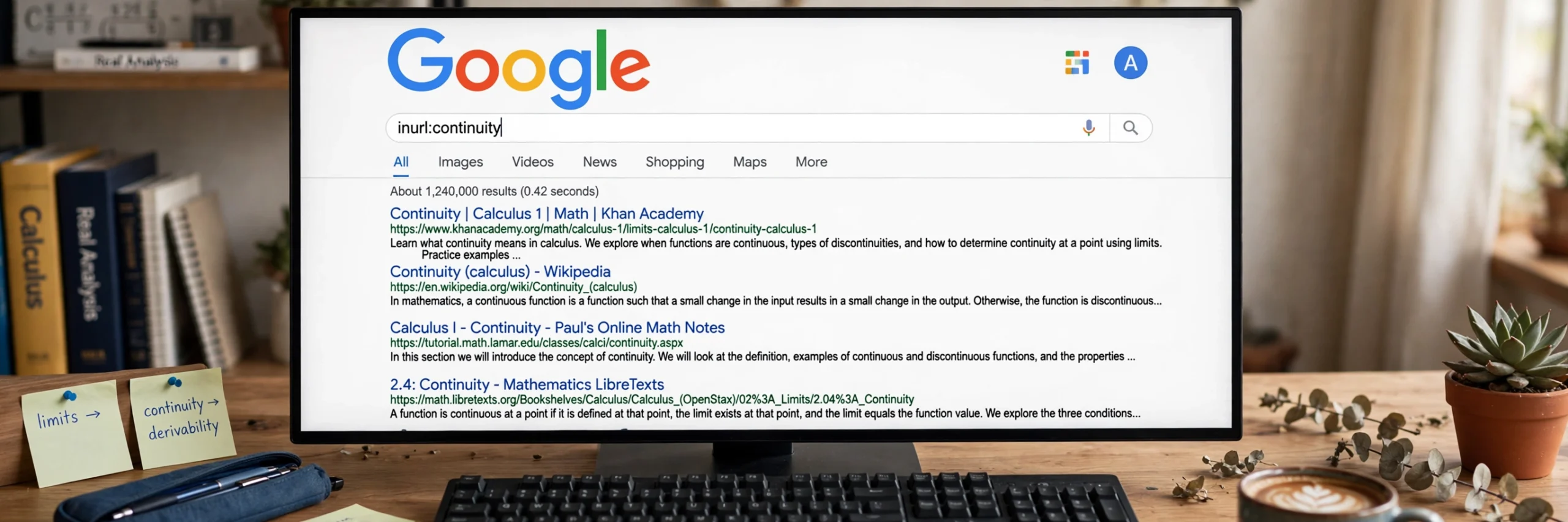
Type inurl:continuity into Google and something curious happens. You did not ask a maths question, yet almost every result is a calculus lesson — university course pages, open textbooks and exam-prep sites, with a few business continuity pages mixed in. Google is not ignoring you. It is doing exactly what you told it to do.
This guide explains what inurl: really searches, why this query returns maths pages, and how to shape it for your goal. Because most people running it are really hunting for help with continuity itself, it also includes a plain-English explainer with worked examples.
What Does inurl:continuity Actually Mean?
inurl: is one of Google’s advanced search operators. It tells Google: only show me pages where this word appears in the URL — the web address itself — rather than anywhere in the page’s text or title.
So inurl:continuity does not mean “explain continuity.” It means “find pages whose address contains the word continuity.” A university lesson stored at an address ending in /continuity qualifies, even before Google considers what the page teaches.
That distinction matters. Ordinary keywords search a page’s content; operators search its structure. Google’s own Search Help pages on refining searches stress one formatting rule: never put a space between the operator and its term. inurl:continuity works; inurl: continuity does not.
Think of it as searching filing labels instead of files. When the label matches what people want — lessons, plans, worksheets — results can be surprisingly precise.
Why Does inurl:continuity Return Mostly Maths Pages?
Three reasons combine to push calculus to the top.
First, universities organise course material in predictable folders. A chapter naturally lives at an address containing “limits” or “continuity,” so thousands of course pages match exactly.
Second, the strongest matches are genuinely authoritative. The continuity section on Mathematics LibreTexts and OpenStax Calculus Volume 1, Section 2.4 on continuity are free, detailed and heavily linked by teachers, so Google trusts them.
Third, “continuity” is ambiguous. Alongside calculus you will see business continuity plans — documents about keeping an organisation running through disruption — and the odd fluid-mechanics page about the continuity equation. The operator cannot tell which meaning you intended; adding words is how you tell it.
How to Use inurl:continuity, Step by Step
- Type
inurl:continuityexactly, with no space after the colon. - Scan the addresses, not just the titles — the URL reveals whether a result is a lesson, a PDF, a syllabus or a company plan.
- If results are too broad, add one refinement at a time from the table below.
- Open the best two or three results and compare, preferring university and open-textbook domains over anonymous homework sites.
Variations That Get You Closer to What You Want
| Query | What it finds |
|---|---|
inurl:continuity |
Any indexed page with “continuity” in its address |
inurl:continuity worksheet |
Practice material — URL and content both point that way |
inurl:continuity site:.edu |
University-hosted pages only |
inurl:continuity filetype:pdf |
PDFs — lecture notes, worksheets, formal plans |
intitle:continuity inurl:limits |
Pages titled “continuity” inside limits sections |
allinurl: business continuity plan |
URLs containing all three words — mostly formal plans |
inurl:continuity -calculus |
Continuity pages, calculus pushed out |
Two patterns matter most. Pairing inurl: with site: is the fastest route to trustworthy study material. Pairing it with filetype:pdf is the fastest route to downloadable documents — what researchers hunting example business continuity plans usually want.
Curious how odd search strings work? Our guide to exploring the online world of digital platforms pairs well with this decoding mindset.
Continuity in Plain English: The Maths Behind the Search
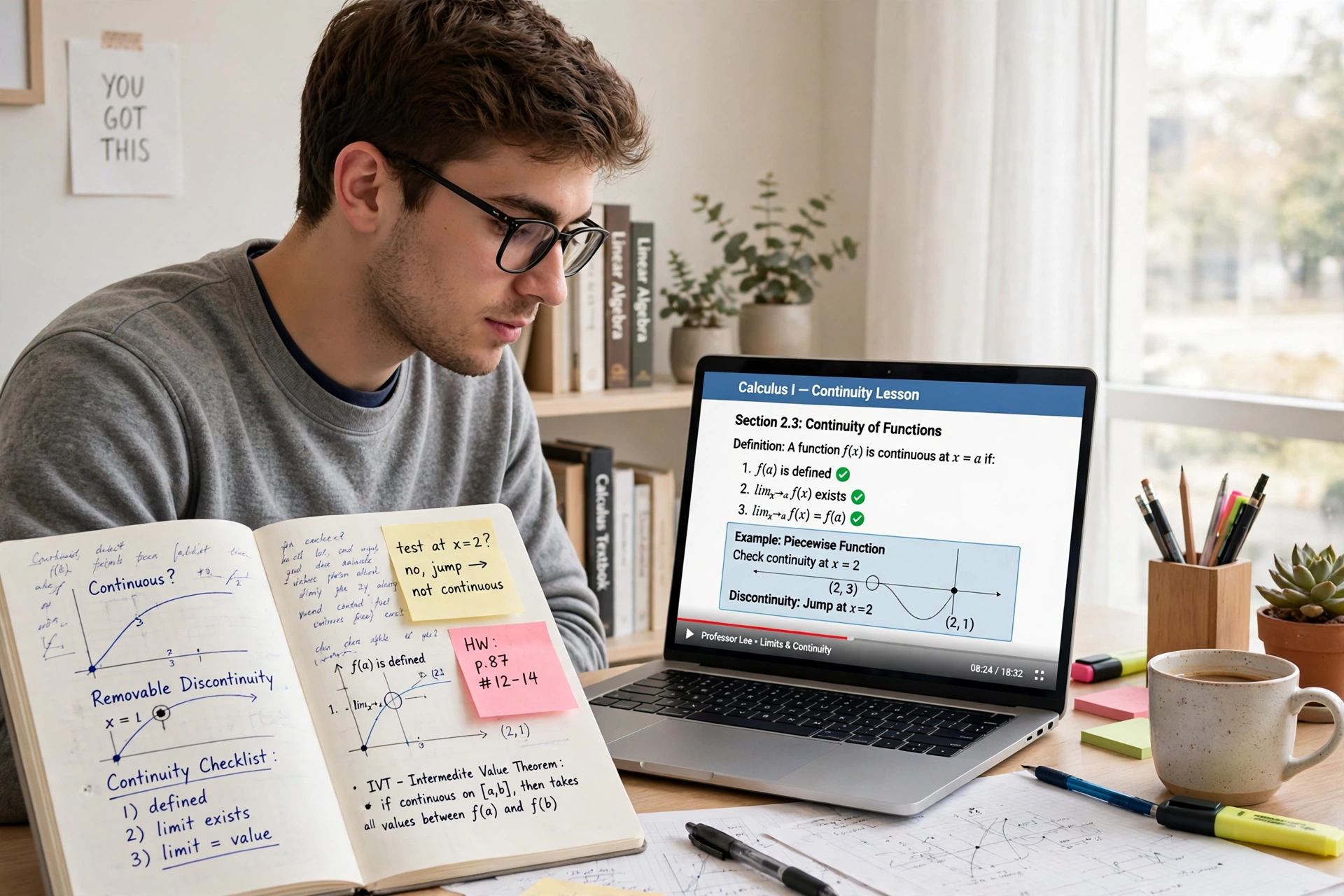
Here is the part most operator guides skip. A function is continuous at a point if its graph has no break there — you can draw through the point without lifting your pencil. Formally, f(x) is continuous at x = a only when all three conditions hold:
- f(a) exists. The function actually has a value at that point.
- The limit exists. As x approaches a from both sides, the values approach the same number.
- The limit equals the value. lim x→a f(x) = f(a). The graph arrives exactly where the point sits.
If any condition fails, the function is discontinuous there — a hole, a jump, or a vertical asymptote. LibreTexts and OpenStax both build their lessons around these three checks, which is why their pages dominate this search.
Worked Examples, Done Slowly
Example 1 — a function that passes. Take f(x) = x² at x = 2. f(2) = 4, so condition 1 holds. From either side, values approach 4, so the limit exists and equals 4. All three pass: f is continuous at 2. Every polynomial is continuous everywhere.
Example 2 — a removable hole. Take f(x) = (x² − 1)/(x − 1) at x = 1. The formula simplifies to x + 1 everywhere except x = 1, where it is undefined — division by zero. The limit approaching 1 is 2, but f(1) does not exist, so condition 1 fails. Because defining f(1) = 2 would fix it, this is a removable discontinuity.
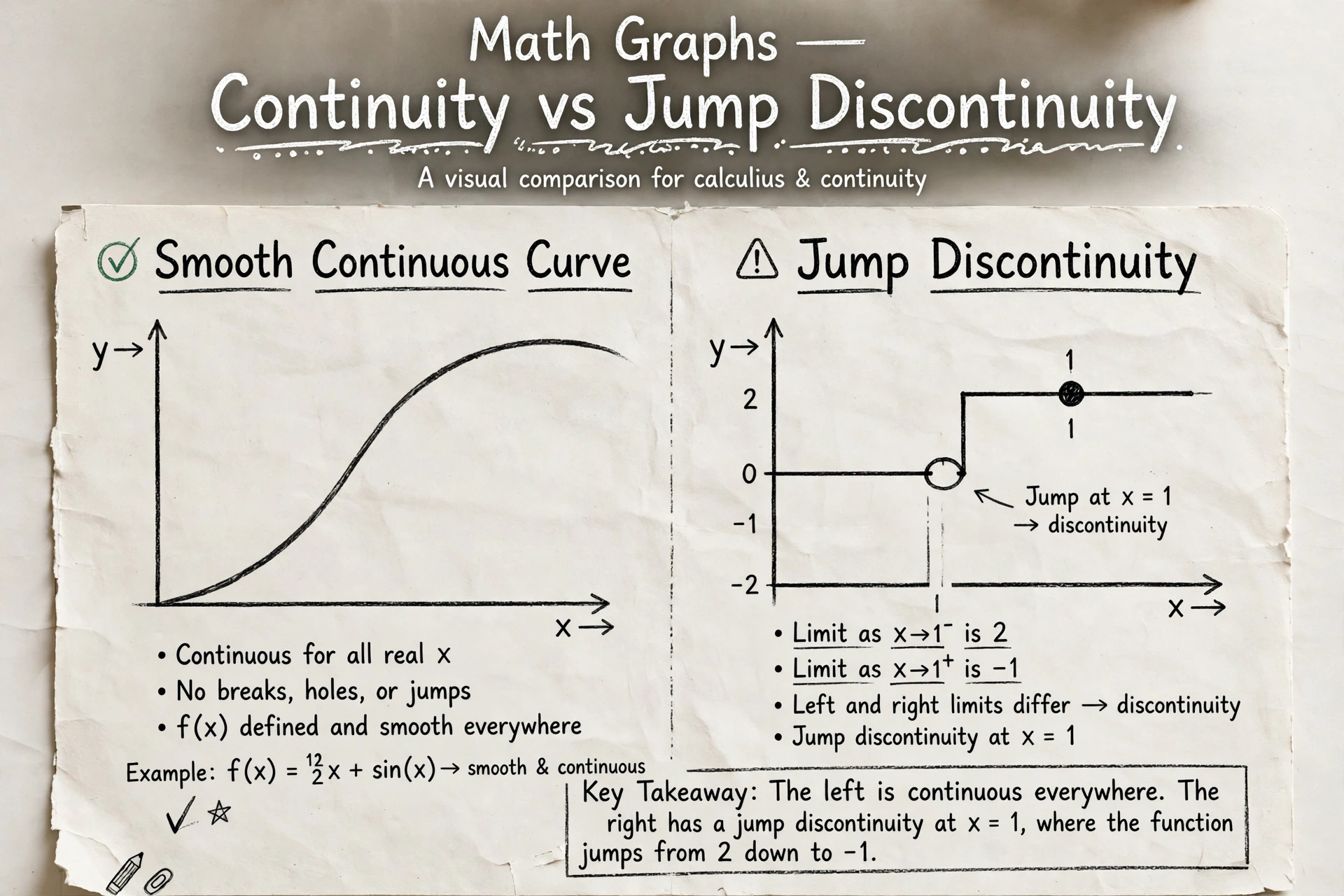
Example 3 — a jump. A piecewise function equal to x + 1 for x < 1 and x + 3 for x ≥ 1 approaches 2 from the left and 4 from the right. The sides never agree, so the limit does not exist and condition 2 fails: a jump discontinuity.
Use the checklist in order. Most mistakes come from checking the limit and forgetting the actual value.
Practical Uses Beyond Homework
Students use this query to find lessons and worksheets that plain searches bury under videos and forums. Teachers use the site:.edu variation to borrow well-structured examples. Researchers and managers flip the intent: adding “plan” steers results toward real business continuity documents usable as templates. SEO and site owners use inurl: on their own domains — site:yoursite.com inurl:blog, for instance — to audit URL structure and spot messy page organisation.
The same detective approach explains other strange strings people paste into Google — we have done similar digging into what an unusual search term actually stands for.

Common Mistakes and Limitations
- Adding a space after the colon turns the operator into ordinary text.
- Expecting a content search.
inurl:matches addresses only. A brilliant lesson at a generic address will not appear. - Forgetting ambiguity. Without extra words, calculus, business and physics meanings compete in one set.
- Trusting results blindly. Google can soften or partially ignore operators, results vary by location and history, and unindexed pages never appear. Newcastle University’s library guide to Google advanced search commands is a useful reminder that operators refine a search — they do not guarantee it.
- Stopping at the first result. The value is comparing a textbook explanation with a worked example, not skimming one page.
Frequently Asked Questions
What is the difference between inurl: and allinurl:?
inurl: requires the following word in the address; other query words can match anywhere. allinurl: requires every word after it to appear in the address — stricter, and better for phrases like business continuity plan.
Why am I only getting calculus results for inurl:continuity?
Because universities publish the most, best-linked pages with “continuity” in the address. Add “plan” or “business,” or exclude maths with -calculus, to steer the query.
Is inurl:continuity useful for anything except studying?
Yes. It locates downloadable continuity plans, syllabuses and document collections, and site owners use the same operator to audit their own URLs.
What are the 3 conditions for continuity?
The function value must exist at the point, the limit must exist from both sides, and the limit must equal the function value. Miss any one and the function is discontinuous there.
Does Google still support the inurl: operator?
Yes, though Google does not promise it will be applied perfectly to every query. If results look off, simplify and add one operator at a time.
Conclusion
inurl:continuity shows how Google reads the web’s structure, not just its words — and surfaces some of the best free calculus teaching available. Add a site:, filetype: or extra keyword and it bends toward business plans, worksheets or site audits. Learn the operator, steal the three-condition checklist, and your next odd-looking search becomes a shortcut.
References
- Mathematics LibreTexts — Continuity (Calculus, APEX): https://math.libretexts.org/Bookshelves/Calculus/Calculus_3e_(Apex)/01:_Limits/1.05:_Continuity
- OpenStax — Calculus Volume 1, 2.4 Continuity: https://openstax.org/books/calculus-volume-1/pages/2-4-continuity
- Google Search Help — Narrow your search results with filters: https://support.google.com/websearch/answer/142143?hl=en&co=GENIE.Platform=Desktop
- Newcastle University Library — Google Advanced Search Commands: https://www.ncl.ac.uk/mediav8/academic-skills-kit/file-downloads/find-and-eval-info/2025%20Google%20Advanced%20Search%20Commands.pdf